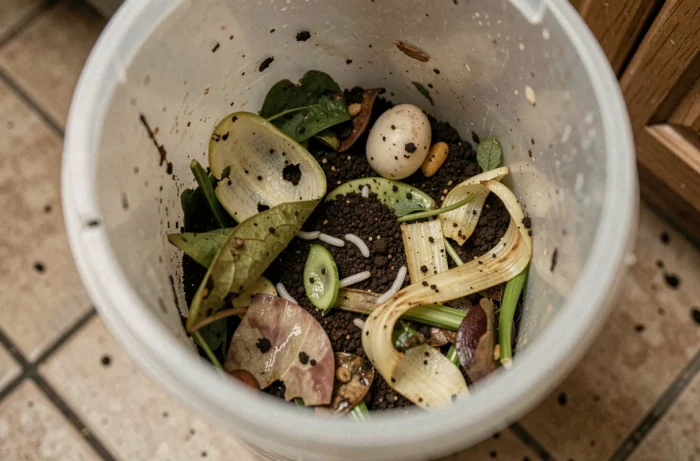
Opening the lid of your trash can and discovering a writhing mass of small white worms is an experience no one wants to relive. These maggots in the trash don’t fall from the sky: they result from a specific chain of events that begins with flies laying eggs attracted by your waste. Understanding this mechanism allows you to act quickly and, above all, to prevent the situation from recurring.
Fly Laying and Organic Waste: The Mechanism in Detail
A housefly lays its eggs directly on decomposing organic matter. Meat, fish, leftover fruit, dirty diapers: any moist and smelly residue is an ideal laying site. The eggs, tiny and clustered, hatch in less than 24 hours when temperatures are high.
The larvae that emerge are precisely the maggots. They feed on the waste for several days before transforming into pupae, then into adult flies that restart the cycle. A single forgetfulness in closing the lid is enough to trigger an infestation.
You can also learn everything about trash maggots to distinguish misconceptions from verified facts about their appearance.
Two factors accelerate the process: summer heat and moisture trapped at the bottom of the bin. A punctured trash bag that allows waste juice to leak down the sides creates a perfect environment for laying. The problem worsens when collection is spaced out, as the larvae then have several days to develop without being disturbed.
Health Risks Associated with Maggots in the Trash
Beyond disgust, maggots pose a real hygiene problem. These larvae develop on decaying matter. They therefore carry pathogenic bacteria on their bodies and in their droppings.
The adult flies that emerge from these larvae then contaminate the surfaces of the home. They land on countertops, food, and dishes. Each contact deposits microbial agents taken from the decomposing waste.
The foul odors that accompany the infestation are not just an inconvenience. They signal advanced degradation of organic matter, producing gases like ammonia. In a confined space (kitchen, trash room of a building), these emissions can cause respiratory irritation in sensitive individuals.
The Specific Case of Professional Premises
In restaurants or food businesses, an infested trash can can lead to non-compliance during health inspections. Poorly sorted organic waste in these contexts fosters infestations that are much more massive than in a domestic household.
Eliminating Maggots: Concrete Methods in Order of Effectiveness
When the larvae are already present, you need to act in two steps: eliminate the existing maggots, then disinfect the bin to remove any laying residues.
Boiling Water, the Quickest Solution
Pouring boiling water directly on the maggots kills them in a few seconds. This is the simplest and least expensive method. After emptying the trash can, generously pour several liters of boiling water onto the bottom and sides.
This technique has a limitation: it does not disinfect the bin thoroughly. Remaining eggs, invisible to the naked eye, can hatch in the following days if you do not follow up with a cleaning.
Cleaning and Disinfecting the Bin
After pouring boiling water, scrub the inside of the bin with one of these solutions:
- Pure white vinegar, applied directly to the sides and bottom. Its acidity destroys organic residues and repels flies with its odor.
- Diluted soda crystals in hot water, effective for loosening ingrained deposits at the bottom of the bin.
- Diluted bleach, which eliminates residual bacteria (to be used with caution and rinsed well).
Thoroughly drying the bin after cleaning is a step often overlooked. A damp bottom becomes attractive to flies again in a few hours. Leave the bin open in the sun if possible, or wipe it down before placing a new bag.
Sustainable Prevention: Reducing the Laying Substrate in the Trash
Killing the maggots only temporarily solves the problem. Prevention is based on a simple principle: depriving flies of what attracts them.
Sorting Organic Waste, an Underestimated Lever
Since January 1, 2024, local authorities must offer a solution for sorting organic waste to residents: individual composter, collective composter, voluntary drop-off point, or dedicated bin. According to the Ministry of Ecological Transition, this obligation targets local authorities and not directly individuals, but it concretely changes what ends up in your residual trash can.
Less organic waste in the gray bin means less substrate for fly laying. Peels, meal leftovers, coffee grounds: by directing them towards composting, you eliminate the main source of attraction.
Everyday Prevention Actions
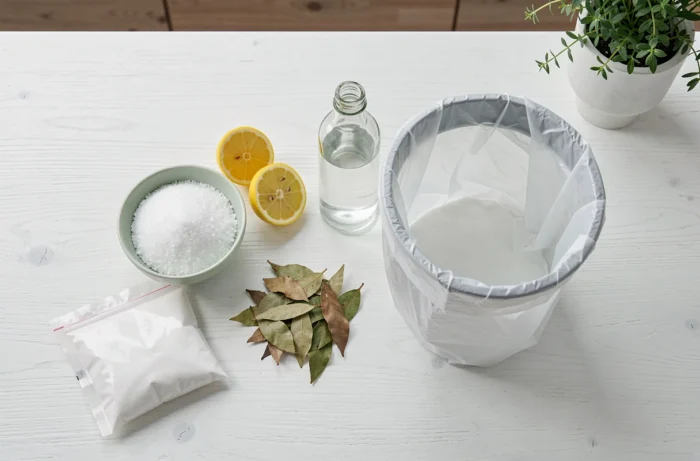
- Wrap meat and fish leftovers in newspaper before throwing them away. This physical barrier limits odors and makes the matter less accessible to flies.
- Always close the lid of the trash can. An ajar bin, even slightly, allows flies to enter within minutes.
- Take out the bags before they are completely full during hot weather. A packed bag retains more moisture and heat.
- A few drops of peppermint or eucalyptus essential oil on the inner walls create a natural repellent against insects.
Cleaning the bin at least once a month, even without visible infestation, prevents the accumulation of organic residues in the corners. Waste juices that dry at the bottom go unnoticed but provide a permanent laying ground.
Maggots in the trash reveal an imbalance between the amount of organic matter deposited and the frequency of cleaning the bin. By reducing organic waste in the residual bag and maintaining a clean and dry bin, the problem disappears sustainably, without expensive products or outside intervention.