Opening an empty cupboard in a new kitchen can be overwhelming. The common reflex is to buy as many accessories as possible all at once, often in sets, to feel prepared. The result: drawers full of items that are used once a year and a cheap frying pan that sticks after the third use. Equipping your kitchen well means choosing a few pieces, but the right ones.
Cooking Materials: How the Coating Affects Daily Use
Before making a list of utensils, one point rarely addressed in traditional guides deserves your attention: the material of your cooking pieces determines their lifespan, maintenance, and even the taste of your dishes.
An uncoated stainless steel frying pan requires a bit of fat and a gradual increase in temperature. In return, it can go in the oven, withstand metal utensils, and last for years without degrading. Stainless steel is suitable for high-heat cooking like searing meat or deglazing a sauce base.
The non-stick coating (often ceramic or PTFE) makes cooking eggs, pancakes, and delicate vegetables easier. Its fragility remains the weak point: a metal spatula or rough stacking in a cupboard can scratch the surface. If you choose this type of pan, plan to use felt pan protectors between each piece to stack them without damage.
You will find detailed comparison sheets on equipment on Cuisine Gratuite, especially to choose between these two families of coatings based on your habits.
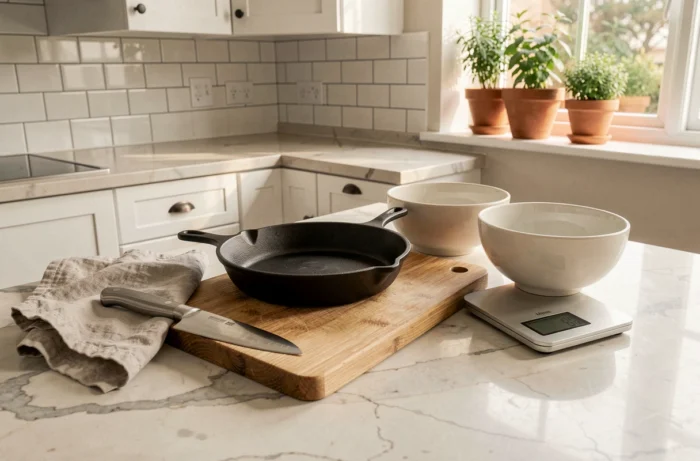
Cast iron (raw or enameled) remains the reference for slow-cooked dishes. Its weight makes it less practical for daily use, but a cast iron pot retains heat better than any other material. One cast iron pot replaces a stockpot, a stew pot, and a baking dish.
Kitchen Knives: Three Blades Are Enough
Have you noticed those blocks of six or eight knives sold in sets? In practice, two or three of them end up doing all the work. It’s better to invest in three high-quality blades than in a complete entry-level set.
- A paring knife (blade 8 to 10 cm) for peeling, trimming, and performing small precision tasks on vegetables and fruits.
- A chef’s knife (blade about 20 cm), used for slicing, dicing, and chopping most ingredients.
- A serrated bread knife, also effective for cutting tomatoes or citrus fruits without crushing the flesh.
A well-sharpened knife is safer than a dull knife. When the blade slips, you press harder, and that’s when the hand slips. A honing steel or a fine-grit stone can sharpen the blade in seconds before each use.
Preparation Utensils and Useful Small Accessories
Once the cooking pieces and knives are chosen, you still need to cover the preparation of common recipes. Again, the selection can remain short.
A cutting board made of hardwood or composite material protects your countertop and preserves the edge of your knives. Avoid glass: it dulls the blades after a few uses. Ideally, have two, one for vegetables and one for meats, to limit cross-contamination.
A whisk, a flexible spatula, and a wooden spoon cover most mixing tasks. The flexible spatula (also called a spatula) scrapes the sides of a bowl or pot better than any other tool. For baking, it quickly becomes an extension of the hand.
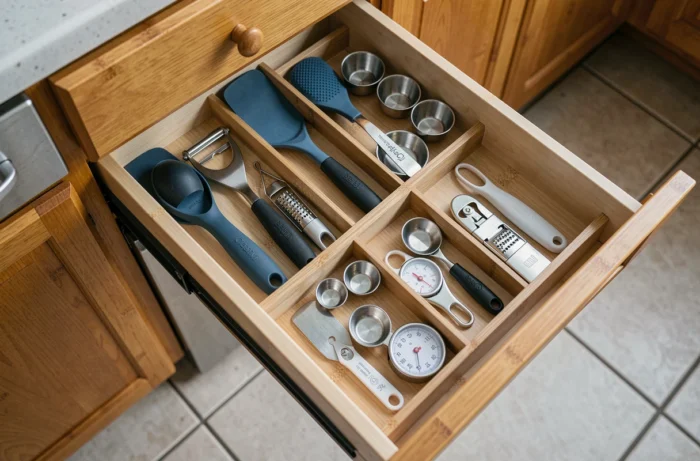
A quality vegetable peeler saves considerable time compared to a paring knife for peeling carrots, zucchini, or potatoes. Choose a model with a swiveling stainless steel blade: it follows the curves of the vegetable and reduces waste.
Pans and Dishes: Start with Two Sizes
A round cake pan (standard diameter around 24 cm) and a rectangular baking dish meet the vast majority of sweet and savory recipes. It’s better to have one versatile pan than five specialized pans that rarely come out of the cupboard.
For the baking dish, ceramic or enameled cast iron offers even heat distribution. Metal heats up quickly but can excessively color the edges of a vegetable gratin.
Energy Consumption of Appliances: A Concrete Criterion
If you buy an electric appliance (kettle, mixer, microwave), check its standby consumption. European eco-design regulations now require that the standby power without display does not exceed 0.5 W, and this threshold will be lowered to 0.3 W on January 1, 2027.
This figure may seem trivial for a single appliance. Multiply it by five or six devices that are always plugged in (coffee maker, microwave, digital display cooktop), and the phantom consumption over a year becomes measurable. Unplugging or using a power strip with a switch remains the most effective action.
Why this criterion in an equipment guide? Because between two kettles at the same price, the one with the best energy class will cost you less over time. The new energy labels (classes A to G without the “+”) make direct comparison easier in stores.
The entry-level utensil market saw a notable increase in volume between 2024 and 2025, driven by low-cost frying pans. This dynamism shows that equipping yourself well does not require a high budget, provided you focus spending on the pieces that really work every day: a good frying pan, a good knife, a sturdy pot. The rest will come naturally, over time with recipes.