Robion does not appear on any ranking of the “most beautiful villages in Provence.” This small town in Vaucluse, nestled on the northern foothills of the Petit Luberon, between Les Taillades and Maubec, nevertheless lives to the rhythm of a very real agricultural activity and a vibrant community life. With around fifty shops, sixty associations, and olive groves that extend up to the first hills, Robion offers a way of life based on proximity rather than on postcards.
Robion, an agricultural village of the Luberon: what the guides overlook
Most tourist pages dedicated to the Luberon categorize Robion as a “charming village.” The term is accurate, but it masks the essential. Agricultural activity still shapes the daily landscape of the municipality, fed by the waters of the Carpentras canal. The cultivated plots stretch to the south of the village, between the houses and the first slopes of the massif.
This is not a frozen backdrop. Market gardening supplies local markets, and the olive groves produce oil that circulates in the short supply chains of the valley. Have you ever noticed that some Provençal villages seem to live solely off tourism? Robion is among those that maintain a visible agricultural economy, without a folkloric showcase.
Local life is not limited to the fields either. For a municipality of this size, the density of services and associations is surprising: sports activities, cultural workshops, neighborhood events. Practical information and the community agenda can be found on robion.fr, providing a concrete glimpse of this vitality.
Built heritage of Robion: Romanesque church, bell tower, and chapels
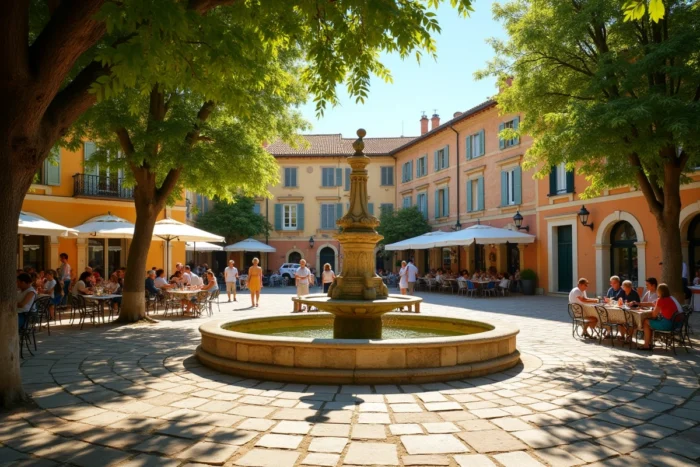
The old village is best explored on foot, starting from the fountain of the Pompe. This former public well transformed into a fountain remains the convergence point of all the alleys. Surrounding it, century-old plane trees create a dense canopy, and the narrow streets radiate upwards towards the top of the village.
The church of Notre-Dame de la Nativité and the old bell tower
The Romanesque church of Notre-Dame de la Nativité dates back to the 12th century. Its simple nave, typical of Provençal Romanesque architecture, contrasts with the later restorations visible on the exterior facades. The old bell tower, on the other hand, is a remnant of the former Saint-Pierre church, dated to the 13th century. One of its bells bears the date of 1489 and continues to chime the hours.
This detail is not trivial. A bell from the late 15th century still in use testifies to a rare continuity of use, even in Provence where many ancient religious buildings exist.
The chapel of Saint-Roch, memory of the plague
Built in 1633, the chapel of Saint-Roch was constructed in gratitude after the community was spared from the plague. It now houses the tourist office and serves as a venue for exhibitions and cultural events. This dual use (memory and living culture) aptly summarizes Robion’s approach: heritage is not museumified but inhabited.
Calades, Portalet, and the source of l’Escanson: a journey through old Robion
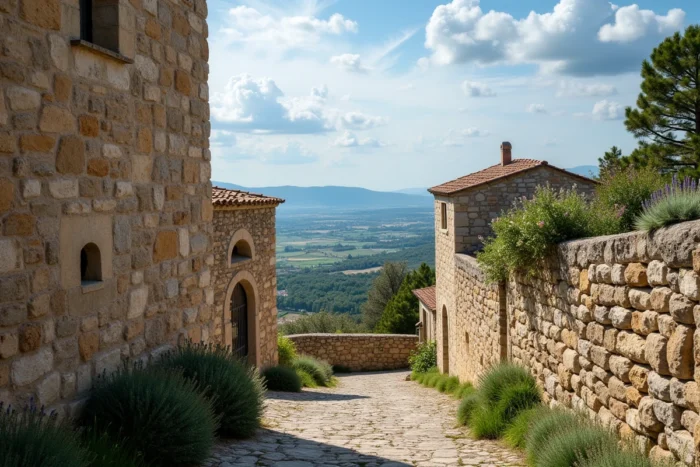
The old village retains a network of calades (cobblestone alleys) that climb towards the former fortified town. The Portalet, a historic access gate, opens onto a flight of stone stairs. This type of passage exists in other villages of the Luberon, but Robion’s remains little frequented by visitors, which radically changes the experience.
Below, the source of l’Escanson feeds a green theater nestled in the vegetation. During heavy rains or in winter, the spring gushes forcefully and transforms the site into a temporary waterfall. For the rest of the year, the place maintains a calm that contrasts with the hustle and bustle of neighboring tourist sites like Gordes or Ménerbes.
A walking route of less than an hour connects these points:
- Start at the fountain of the Pompe, under the century-old plane trees, and ascend via the calades towards the Portalet
- Pass by the church of Notre-Dame de la Nativité and take a glance at the old bell tower of the Saint-Pierre church
- Descend towards the chapel of Saint-Roch, then towards the green theater and the source of l’Escanson
- Return through the lower alleys of the village, lined with dry stone houses and enclosed gardens
Art of living in Robion: what unfolds daily in Provence
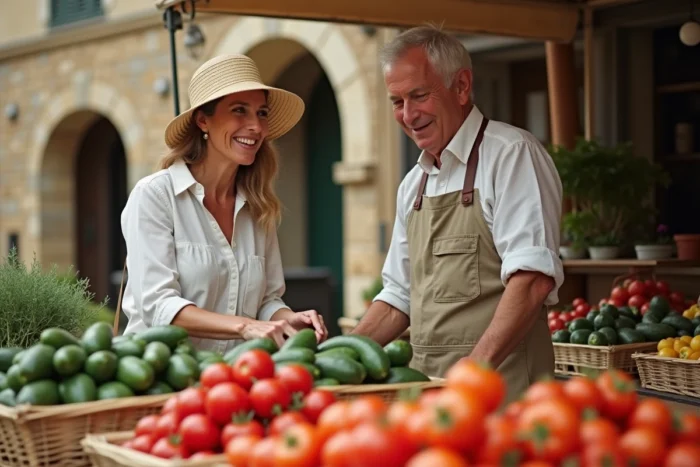
The expression “Provençal art of living” has become a marketing cliché. In Robion, it encompasses something more concrete. Everything is within reach: food shops, health services, schools, sports facilities. This proximity establishes a residential lifestyle that attracts residents seeking rurality without isolation.
The chapel of the Rosary, dated 1656 and adjoined to the Romanesque church, occasionally hosts community events. Local associations organize workshops, outdoor concerts in the green theater, and seasonal markets. This dense associative fabric, for a municipality of a few thousand inhabitants, constitutes a distinctive marker compared to neighboring villages that are more focused on tourism.
Why does this balance hold? Probably because Robion is located on the Cavaillon-Apt road, a thoroughfare that ensures regular traffic without transforming the village into a mass destination. The tourist Luberon passes by, but Robion lives within it.
This discreet positioning, between preserved Romanesque heritage and active agriculture, gives Robion a character that more media-covered villages in the Luberon have sometimes lost. The visitor who takes the time to climb up to the Portalet or sit under the plane trees of the Pompe discovers a village where heritage is not a spectacle, but the ordinary backdrop of a local life that continues.