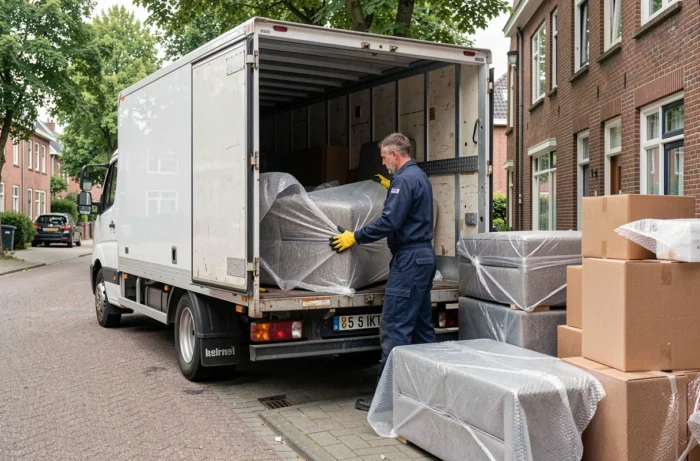
A 15 m³ truck offers a loading space that corresponds, in volume, to about half of a standard shipping container. This capacity is sufficient for moving a small to medium-sized home, but the displayed volume does not tell the whole story: the actual payload and the geometry of the loading area determine what the vehicle can actually carry.
Payload of a 15 m³ truck: the limit that volume does not show
Most guides focus on cubic meters. The trap is there. A 15 m³ truck rated at 3.5 tons (the threshold for a B license) does not have an unlimited payload. On some models, especially electric ones, the payload drops to around 790 kg including fittings (as in the case of the Ford E-Transit L4H3, according to MyUtilitaire).
In practical terms, filling the volume with boxes of books or archives is enough to exceed this limit. A standard box of books weighs between 20 and 30 kg. Forty boxes of this type already represent more than 800 kg, not counting the furniture. Before making a list of items for a 15m³, the first step is to check the payload indicated on the registration certificate of the rented vehicle.
For a classic thermal model with a 3.5 t GVW, the payload generally ranges from 1,100 to 1,300 kg. The margin is more comfortable, but it still requires sorting between heavy and bulky items.
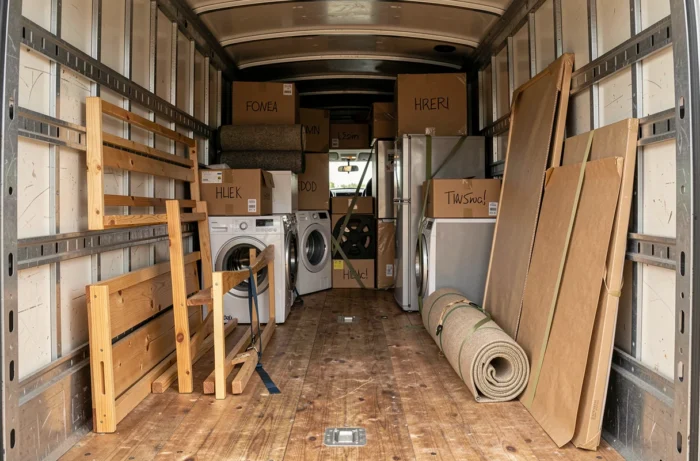
Furniture and boxes in a 15 m³: correspondence by type of housing
The volume of 15 m³ falls between the two common levels offered by rental companies (10 m³ and 20 m³). Here’s what it represents according to the size of the housing.
Studio or furnished T1
A studio fits comfortably in a 15 m³, with some margin. A bed, desk, table, chairs, small appliances, and about twenty boxes rarely occupy more than 8 to 10 m³. The remaining volume allows for adding a bike, shelves, or leisure equipment.
T2 or small T3
This is the natural territory of the 15 m³. An apartment with two to three rooms, furnished in a standard way (sofa, double bed, dining table, dresser, medium wardrobe), plus about thirty boxes, fills the available volume without excess. A well-organized T2 fits in one trip.
Beyond T3, or if the housing contains very bulky furniture (three-door wardrobe, upright piano, massive bookshelf), the 15 m³ becomes insufficient. A 20 m³ will be more suitable.
Items that pose problems despite the volume
- A corner sofa often exceeds two meters in length and occupies a significant portion of the truck’s width, forcing boxes to be stacked around it.
- A refrigerator or washing machine, transported upright, takes up little floor space but is heavy and reduces the remaining payload.
- Mattresses, even folded in half, consume a lot of vertical space and complicate the stacking of boxes behind them.
Loading rules and overload: current penalties
Typical contents detail furniture and boxes but overlook the consequences of overload. In 2026, regulatory recalls have increased.
Exceeding the authorized payload exposes one to a fixed fine and, in the case of a significant excess, to the immobilization of the vehicle. A roadside check with overload also engages the insurance’s responsibility, which may refuse to cover a claim that occurred while exceeding the GVW.
The reflex to adopt: weigh the heaviest items before loading (a bathroom scale is sufficient for boxes) and maintain a safety margin. Overload is not always visible to the naked eye, especially when the truck’s volume is only half filled but the contents are dense.
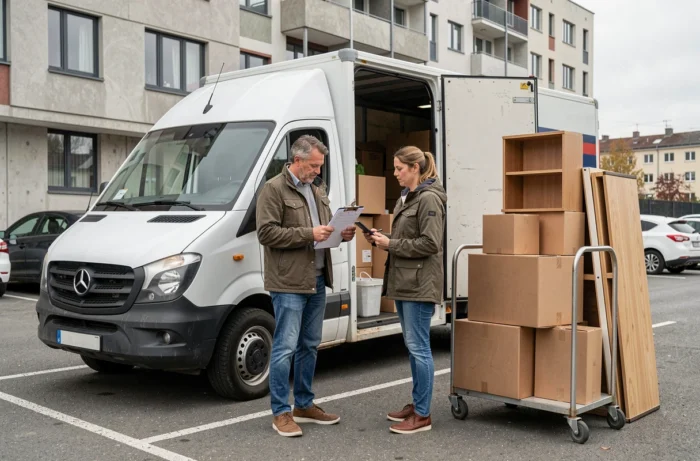
Optimizing the loading of a 15 m³ truck: order and method
The usable volume depends as much on how to load as on the truck itself. Two identical moves in content may require one or two trips depending on the organization of the loading.
The heaviest and most stable items should be placed at the back, against the rear wall of the truck bed. Appliances, protected dish boxes, flat bed bases: they form a solid foundation. Dismantled furniture (table legs removed, shelves flat) frees up surprising volume compared to the same furniture left assembled.
- Systematically dismantle everything that can be: table legs, wardrobe doors, rods. Keep the screws in labeled bags.
- Stack boxes by decreasing weight, with the heaviest at the bottom and the lightest on top.
- Fill empty spaces (inside a washing machine, dresser drawers) with linen or small soft boxes.
- Strap tall loads (refrigerator, wardrobe) to the side walls to prevent tipping during turns.
The layered horizontal loading remains the most reliable method for an individual. Each layer forms a stable plane before moving on to the next. Tall and narrow furniture (floor lamps, vacuum cleaners) should be wedged in last, in the side gaps.
B license and restrictions for a rented 15 m³
A 15 m³ truck can be driven with a B license, provided that the GVW does not exceed 3.5 tons. The vehicles offered for rent by mainstream companies all respect this threshold. In case of doubt, the number appears on the registration document in section F2.
Another often overlooked point: low emission zones (LEZ) may prohibit access to certain utility vehicles depending on their Crit’Air sticker. Before booking a truck for a move in downtown Lyon, Paris, or Marseille, checking the vehicle’s classification avoids an unpleasant surprise on the day.
The 15 m³ remains the most versatile format for a small surface move or occasional transport of bulky items. Its real limit is not the volume, but the weight. Keeping this reflex in mind at the time of loading changes the game between a smooth trip and the risk of a fine or mechanical breakdown.