
The online money transfer from France via Western Union relies on a set of verification mechanisms that have significantly evolved in recent months. Mastering these layers of security, both from the sender’s side and the service provider’s side, determines the reliability of each transaction.
Verification of Payee and SEPA transfer to Western Union
Since October 9, 2025, payment service providers in the euro zone are required to offer a Verification of Payee (VoP) service for SEPA transfers. This system directly concerns users who fund their Western Union account via bank transfer.
When you enter the Western Union IBAN in your banking interface, the bank compares the name of the beneficiary provided with the actual account holder associated with that IBAN. In case of a mismatch, an alert appears before validation. The bank is not obligated to block the transaction, but it must clearly inform the customer of the potential risk.
This check is free of charge. We recommend copying exactly the business name appearing on the invoice or Western Union RIB to avoid a false positive. A simple typographical variant (missing accent, abbreviation) can trigger the alert and delay processing.
Making an online money transfer via Western Union therefore requires verifying in advance the exact match between the entered name and the one registered with the payment institution.
Enhanced traceability through the Transfer of Funds Regulation
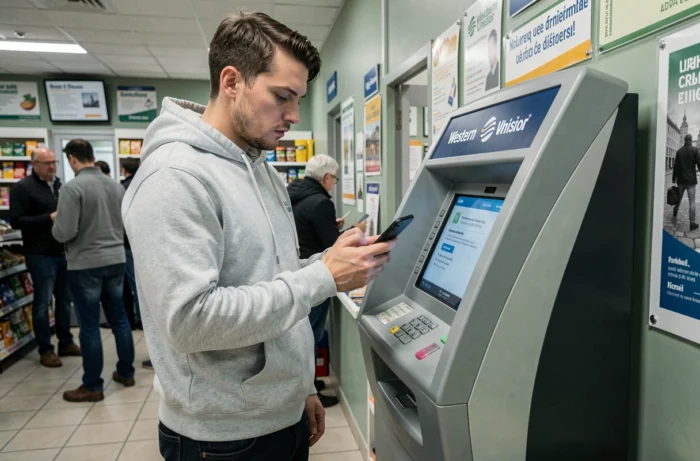
The European TFR (Transfer of Funds Regulation), adopted in May 2023, imposes a complete traceability of the identity of the sender and the beneficiary for any transfer passing through a European provider. Western Union, as an authorized payment institution, applies these requirements to every transaction initiated from France.
In practice, this means that the full name, address, and a unique identifier (account number or transaction ID) accompany the funds throughout the chain. For transfers to countries outside the SEPA zone, this data is transmitted to the beneficiary’s provider, facilitating anti-money laundering checks in the receiving country.
Since December 2024, this obligation also extends to crypto-assets when a European provider is involved. If you use a digital wallet to fund your Western Union account, the same traceability rules apply.
Payment methods and associated risk levels
The choice of payment method directly influences the security and speed of the transfer. Each option presents a distinct risk profile.
- The credit or debit card offers the most direct protection: in the event of a fraudulent transaction, the chargeback mechanism allows you to dispute the operation with the card issuer.
- The bank transfer now benefits from VoP but remains irreversible once validated. It is suitable for higher amounts, where fixed fees weigh proportionally less.
- Mobile wallets (Apple Pay, Google Pay) add a layer of tokenization: the actual card number is never transmitted to Western Union, reducing the risk of compromising banking data.
- Cash payment at the point of sale remains available for those without a bank account, but it does not benefit from any electronic recourse in case of a dispute.
We observe that the combination of mobile wallet and biometric authentication (Face ID, fingerprint) is currently the channel least exposed to interceptions.
Western Union account security: parameters to lock down
Beyond the payment method, the robustness of the user account determines the overall level of protection. Several parameters deserve special attention.
Two-factor authentication and alerts
Activating two-step verification (2FA) on the Western Union account blocks almost all unauthorized access attempts. The temporary code sent via SMS or generated by an authentication app is added to the traditional password.
Setting up transaction notifications via email or push allows for immediate detection of any operation not initiated by the account holder. In case of a suspicious alert, the account can be frozen directly from the app.
Transfer limits and progressive identity verification
Western Union applies a progressive identity verification system. An unverified account is limited to low amounts. Submitting a valid ID (national identity card, passport) and proof of address unlocks higher limits.
This progressive mechanism meets the requirements of the AML-CFT regulation (anti-money laundering and counter-terrorism financing) supervised in France by the ACPR. Each level crossed corresponds to an increased level of due diligence.
Warning signs when transferring money online from France
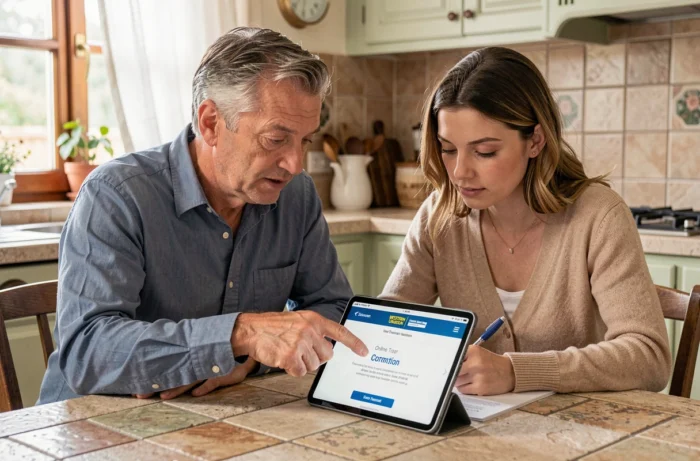
Technical security does not protect against social engineering. The most common fraud on transfer platforms exploits the trust of the sender, not a flaw in the system.
- A beneficiary requesting a cash send to a country different from where they claim to reside is a strong signal.
- Any artificial time pressure (unverifiable medical emergency, fictitious administrative block) should suspend the operation.
- A last-minute change in the beneficiary’s bank details, communicated via email or messaging, requires verification through a separate channel (direct phone call).
Western Union allows real-time tracking of each transfer thanks to the MTCN (Money Transfer Control Number). We recommend never sharing this number with the beneficiary before independently confirming their identity.
The overlay of bank VoP, the European TFR, and Western Union’s internal controls forms a multilayered security system. Each link has its limits, but their combination significantly reduces the exposure surface. The most vulnerable parameter remains the user themselves, and no regulation can replace vigilance when validating a transfer order.