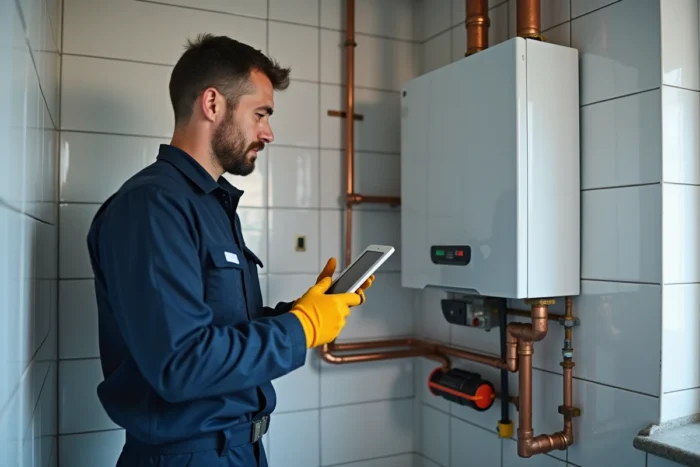
Replacing a gas boiler is not just about swapping out the device. The closure of CEE grants for gas boilers since January 2024 and the planned exclusion of gas from MaPrimeRénov’ accompanied pathway starting in September 2026 completely reshapes the technical and financial considerations of the project.
Sizing and connection constraints when changing a gas boiler
We regularly observe oversized installations because the power calculation has been based on the old device without taking into account the insulation work carried out in the meantime. Sizing should start from an updated thermal assessment: heat losses through walls, air renewal, and the supply temperature of the circuit.
On an existing high-temperature radiator circuit, a condensing gas boiler will only condense effectively if the return temperature drops below 55 °C. Without network adaptation (adding radiators, switching to low temperature), the actual efficiency remains close to that of a standard boiler.
The flue connection deserves special attention. A condensing boiler produces humid and acidic flue gases. The original masonry flue must be lined with stainless steel or polypropylene; otherwise, condensation will degrade the flue within a few seasons. In a collective housing setting, switching to a sealed flue simplifies evacuation but requires compliance with regulatory distances from neighboring openings.
Before changing the gas boiler, we recommend checking the condition of the existing flue and the compatibility of the hydraulic network. These two points condition the actual budget of the project far more than the price of the device itself.
End of CEE aids and MaPrimeRénov’ restrictions: impact on energy choice
The removal of the CEE boost for gas boilers since January 2024 has eliminated the main direct aid for installing a new gas device. CEE now focuses on alternative equipment: heat pumps, connection to a heat network, biomass.
Starting in September 2026, retaining gas heating in a comprehensive renovation will exclude the housing from the MaPrimeRénov’ accompanied pathway. For a homeowner considering insulation of the envelope coupled with the replacement of the boiler, keeping gas becomes a direct financial barrier.
In practical terms, this means that the choice of energy must be made even before the choice of device. Three scenarios emerge:
- Gas replacement with gas (condensing): relevant only if no comprehensive renovation is planned in the short term and if the gas network is already in place, but without significant financial aid
- Switching to an air-water heat pump: eligible for CEE and MaPrimeRénov’, compatible with an existing radiator network provided the operating temperature is checked
- Hybrid solution (heat pump + gas backup): retains the gas connection for cold spikes while qualifying for certain aids, provided the main device is the heat pump
The project timeline therefore conditions the available aid envelope. Delaying a replacement beyond September 2026 without having anticipated the energy change could cost several thousand euros in lost subsidies.
Choosing the heating engineer and RGE certification for replacement
Only a certified RGE professional (Recognized Guarantee of the Environment) can mobilize public aid schemes. This certification attests to training in efficient equipment and regular monitoring of completed projects.
We recommend checking three points before signing a quote:
- The active RGE mention corresponding to the type of work (qualification “gas heating” or “heat pump” depending on the project)
- The completion of a prior technical visit with a survey of the characteristics of the existing network, the flue, and the ventilation of the boiler room
- The provision of a detailed quote separating the cost of the device, the removal of the old boiler, any flue lining, and the commissioning
A global quote without detailed breakdown makes it impossible to compare artisans and often hides missing services (flushing the circuit, adjusting the heating curve, balancing the radiators).

Commissioning and annual maintenance of the gas boiler
Commissioning is not just about turning on the device. It includes filling and purging the circuit, checking gas tightness, adjusting service pressure, and programming the regulator. For a condensing boiler, the connection of the condensate drainage to the wastewater network must be checked: poorly drained condensate can cause acidic backflows in the siphon.
Annual maintenance is a legal obligation for any gas boiler, regardless of its power. It includes cleaning the burner, checking the heat exchanger, measuring combustion efficiency, and verifying the carbon monoxide level in the flue gases. The maintenance certificate conditions coverage by home insurance in case of a claim.
A properly maintained device retains its nominal efficiency over time. Conversely, a burner fouled by just a few tenths of a millimeter is enough to degrade efficiency and increase pollutant emissions.
Replacing a gas boiler is now part of a broader energy arbitration. Anticipating the choice of energy before the choice of device helps secure access to aids and avoid a quickly obsolete investment from a regulatory standpoint.