Transforming your home into a cocoon is not just about piling throws on a sofa. The topic touches on how an interior affects the comfort felt, room by room, through choices of materials, light, and colors that interact with each other. The 2026 decor trends confirm this shift: deep natural palettes, textured fabrics, and layering of light sources replace purely decorative approaches.
Natural materials and textured fabrics: the foundation of a cocooning interior
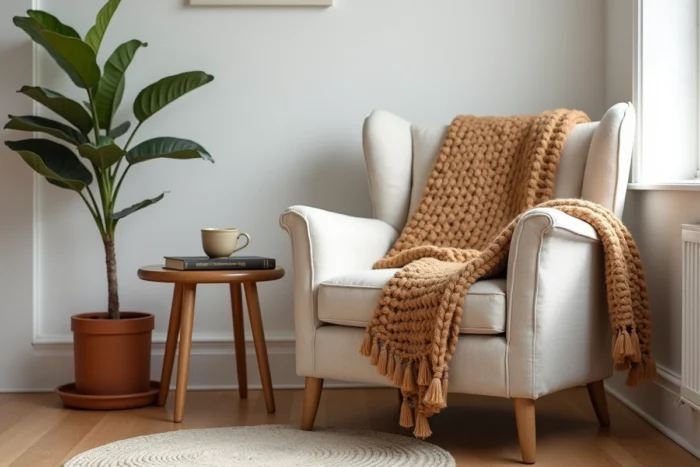
The feeling of cocooning starts with touch. A living room dressed in washed linen, boucle, or thick wool does not provide the same sensation as a space dominated by smooth, cold surfaces. The 2026 trends place texture as the main lever of cocooning atmospheres, even before color.
Washed linen on a sofa or curtains brings a crumpled, lively aspect that ages well. Boucle, popularized on armchairs and headboards, adds visual relief without overloading the room. These materials require moderate maintenance, but they react differently to wear: linen develops a patina, while boucle can pill if the fabric density is low.
The return of dark woods (walnut, mahogany) marks a break from the light Scandinavian oak that has dominated interiors in recent years. These woods bring a more pronounced visual warmth, suitable for living spaces like the living room or bedroom. Rattan and wicker are also making a comeback, adding a “country chic” lightness to the atmosphere. To delve deeper into these trends, Partagez’s home portal gathers resources on interior design and decoration.
Modular lighting: layering light sources in every room
A single ceiling light, even a powerful one, does not create an enveloping atmosphere. The 2026 trend for a cocooning living room or bedroom relies on the layering of multiple light points: a pendant light from the ceiling, wall sconces, and table lamps placed at different heights.
The goal is to be able to modulate the intensity according to the time of day. In the evening, turning off the ceiling light and keeping only the low lamps radically changes the perception of a space. Warm temperature bulbs (around 2,700 kelvins) enhance this effect, whereas a cold white light produces the opposite.
Candles and garlands: complements or decorative traps
Candles remain a classic of cocooning, but their use deserves careful consideration. Placed in small groups on a tray, they structure a corner of the room. Dispersed everywhere without logic, they create visual clutter. String lights work in a bedroom or hallway, provided they remain discreet: a single line along a shelf is sufficient.
Cocooning color palette: how natural shades change daily life
Colors have a direct impact on the ambiance of a room, and the 2026 choices lean towards deep natural palettes: sage green, deep blue, ochre, terracotta, caramel. These shades share a common point: they absorb light instead of reflecting it harshly, which softens the volumes.
Painting all four walls of a living room in terracotta can work if the room is well lit naturally. In a north-facing bedroom, a single accent wall in deep blue behind the bed, combined with off-white on the other walls, avoids the cave effect.
- Sage green is suitable for living areas and bathrooms, where it easily pairs with light or dark wood
- Ochre and caramel warm up a living room without closing it off, especially when combined with light textiles
- Deep blue works better as an accent (headboard, alcove, bookshelf) than on large surfaces in small spaces
Field reports diverge on this point: some decorators recommend daring to use color on all surfaces, including the ceiling, while others find that in modestly sized homes, a single accent wall produces a better balance.
Storage and decluttering: the invisible foundation of comfort
An overloaded cocooning interior loses its soothing effect. Storage is not a glamorous topic, but it is the invisible foundation upon which any successful ambiance rests. A well-organized room appears larger, calmer, and highlights decorative choices.
The principle is simple: every visible object in a room should be there by choice, not by default. Closed storage (built-in closets, chests, benches with storage space) allows keeping essentials accessible without cluttering the view.
Cocooning bedroom: prioritize the bed and reduce the rest
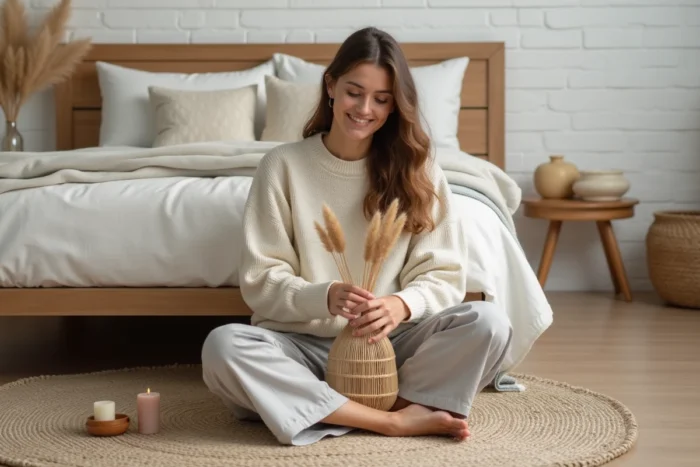
In a bedroom, the bed is the center of gravity. Bedding in natural materials (linen, thick cotton), stacked pillows, and a textured throw are enough to set the mood. Nightstands should remain clear: a lamp, a book, no more.
The floor also plays a role often underestimated. A long-pile rug or thick wool at the foot of the bed transforms the feeling upon waking. The contact of bare feet on a soft material, rather than on a cold floor, contributes as much to comfort as a beautiful bedspread.
Adapting the cocooning atmosphere according to the room and the season
A cocooning living room and a cocooning bedroom do not respond to the same constraints. The living room accommodates multiple activities (reading, dining, conversation), which requires an adaptable atmosphere. The bedroom, on the other hand, has only one main function: rest.
- In the living room, prioritize removable cushions and throws that can be adapted to the season: lightweight linen in summer, wool or faux fur in winter
- In the bedroom, focus on bedding that can be layered to adjust warmth without changing the entire set
- In a reading nook or office, a single warm accent lamp and a comfortable chair create a micro-cocoon in a larger space
Cocooning decor is not fixed in a winter aesthetic. Natural materials like rattan or linen also work in summer, provided dark shades are replaced with lighter tones. The cocoon adapts to the rhythm of life, not the other way around.