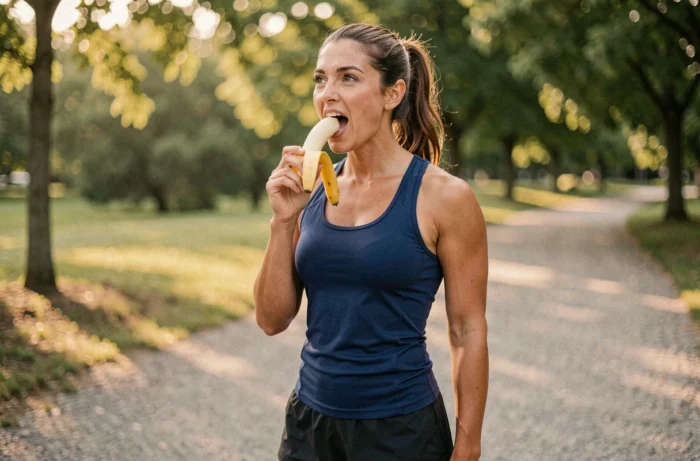
The banana is the most common fruit found in sports bags, locker rooms, and race refreshment stations. Its nutritional profile makes it a logical candidate to support physical effort, but not all bananas are equal depending on when they are consumed. The ripeness of the fruit, the chosen variety, and the type of activity practiced significantly alter what the banana provides to the body.
Glycemic index and ripeness: what really changes in the athlete’s banana
The most underestimated factor in choosing a banana for sports is its degree of ripeness. A green banana contains a high proportion of resistant starch, a carbohydrate that the body breaks down slowly. Its glycemic index is significantly lower than that of a ripe banana, which causes a gradual rise in blood sugar levels.
In contrast, a well-ripened banana, with brown spots on its skin, has converted most of this starch into simple sugars (glucose, fructose, sucrose). Digestion is faster, and energy is available more quickly.
This distinction has direct consequences on the field. To identify the best bananas for sports, one must first know when during the effort cycle they plan to consume them. A bright yellow banana with a few spots is better suited just before intense training, while a still firm and slightly green banana will be more appropriate for a meal taken two or three hours before the effort.
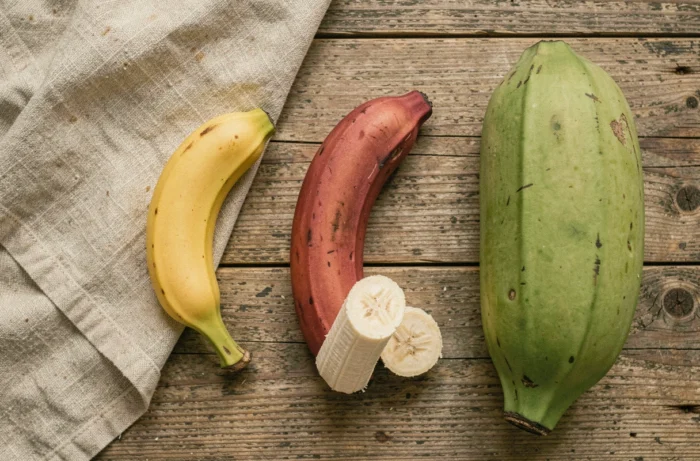
Field reports vary on one point: some athletes report digestive discomfort with bananas that are too green, related to the resistant starch that the digestive system does not completely break down. The compromise often lies around a uniformly yellow banana, without green spots at the ends but not yet speckled with brown.
Cavendish, frécinette, or plantain: which variety for which effort
Almost all bananas sold in France belong to the Cavendish variety. This is the one found in all supermarkets, and it is also the most studied in the context of sports nutrition. Its neutral taste and predictable texture make it a reliable choice.
The frécinette (sometimes called baby banana) is smaller, sweeter, and more fragrant. Its small size makes it convenient for a quick snack between sets or at halftime. Its content of simple sugars is comparable to that of a ripe Cavendish, but the smaller portion allows for better energy intake control.
The plantain banana, on the other hand, is not eaten raw. It requires cooking and is more integrated into complete meals. For an athlete, it can fit into a recovery meal rich in complex carbohydrates, but it is not intended to replace dessert bananas in an immediate effort context.
- Cavendish: versatile, available everywhere, well-suited for all moments of effort (before, during, after)
- Frécinette: smaller portion, very sweet, ideal as a quick snack or in a post-workout smoothie
- Plantain: to be cooked, relevant only in a structured recovery meal, not as a snack
Potassium and cramps: what the banana really provides to muscles
The banana is often associated with potassium, and potassium with cramps. The link between dietary potassium and the prevention of cramps remains debated in the scientific literature. Exercise-related cramps involve multiple factors: neuromuscular fatigue, dehydration, sodium imbalance.
The banana does provide potassium in significant amounts, but also vitamin B6, magnesium, and easily digestible carbohydrates. It is this combination that makes it a relevant fruit for sports, not just its content of a single mineral.

In practice, consuming a banana after exercise helps replenish muscle glycogen stores. The combination of banana and a protein source speeds up recovery compared to carbohydrate intake alone. A yogurt with a mashed banana or a banana-milk smoothie are simple and effective recovery snacks.
Organic bananas, storage, and transport: practical criteria for athletes
The choice between organic and conventional bananas depends on personal preferences. The thick skin of the banana serves as a natural barrier that limits the contact of surface residues with the flesh. For a fruit that is systematically peeled, the difference in ingested residues remains low.
Storage poses a more concrete problem for athletes. A banana bought on Monday will not have the same nutritional profile by Friday. To manage this discrepancy:
- Buy bananas at different stages of ripeness to have one suitable for each day of the week
- Separate bananas from the rest of the fruit bowl, as they accelerate the ripening of neighboring fruits by releasing ethylene
- Avoid the refrigerator for still green bananas (the cold halts ripening), but use it to slow down an already ripe banana
For transport in a sports bag, the frécinette withstands shocks better due to its small size. A Cavendish placed in a hard box or a banana case prevents crushing and staining of belongings.
The stage of ripeness remains the primary selection criterion, far ahead of variety or label. A banana that is too green consumed just before a match can cause digestive discomfort, while a banana that is too ripe eaten two hours before may no longer provide energy at the right moment. Adapting the skin color to the timing of the effort is the simplest and most effective gesture to make the most of this fruit.