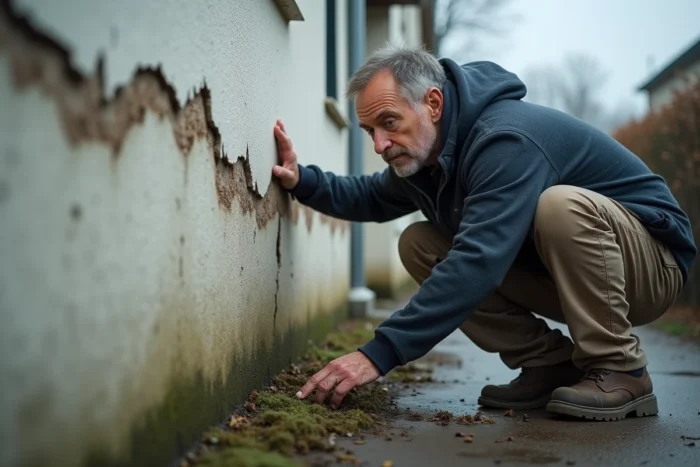
After several months of rain, nighttime frost, and persistent humidity, the exterior walls of a house endure repeated mechanical stress. As soon as the first days of thaw arrive, some damage becomes visible on the facade, sometimes in unexpected places. Spotting these signs early helps prevent water from penetrating deeper into the materials and turning an aesthetic flaw into a structural problem.
Spalling and powdery joints: damage often mistaken for dirt
Have you ever noticed small chips of brick at the base of a wall in spring? This phenomenon has a technical name: spalling. It refers to the superficial bursting of brick or stone caused by water that has penetrated the material, then frozen and expanded inside.
Mild and very humid winters, where rain alternates with slightly negative nights, multiply these freeze-thaw cycles. The facade then undergoes dozens of micro-aggressions in just a few weeks. The result: crumbling surfaces, pieces breaking off, and mortar joints reduced to powder.
This type of degradation often goes unnoticed because it is mistaken for dust or accumulated dirt. Look closely at the base of the walls and the areas exposed to the north or east, where humidity lingers the longest. If you see mortar sand on the ground or surfaces that feel grainy to the touch, the wall has lost part of its outer protection.
Bringing in a facade repair and cleaning company at this stage is a light intervention, much less costly than a complete overhaul after several seasons without treatment.
Impact testing and moisture meter: diagnosing beyond what the eye sees
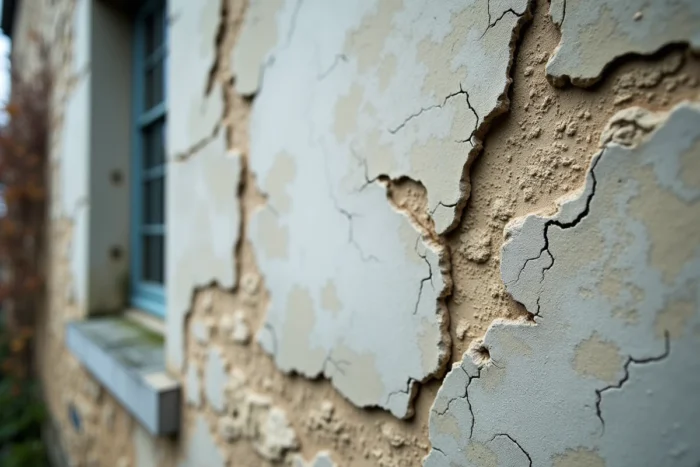
A coating may appear intact on the surface while it has detached from the supporting wall underneath. Water trapped between the coating and the masonry creates an invisible pocket that weakens the entire area. This is the principle of “false dryness” applied to the exterior.
The screwdriver handle test
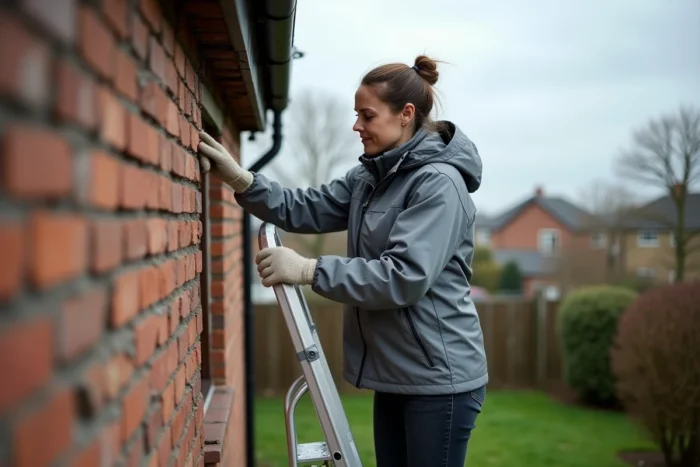
Take a simple screwdriver and gently tap the facade with the handle, about every thirty centimeters. A healthy coating produces a full, dull sound. A detached area sounds hollow, as if you were hitting a drum.
Focus on three at-risk areas:
- The base, between the ground and the first meter of height, where capillary rise and rain splashes converge
- The perimeters of windows and doors, where seals age more quickly due to expansion
- The corners of the building and facades exposed to prevailing winds, which receive the most driving rain
The moisture meter to make the call
A surface moisture meter, available for a few dozen euros at a hardware store, measures the moisture level within the thickness of the wall. Placed against the facade, it provides an instant reading. An abnormally high level in an area that sounds hollow confirms active infiltration.
This dual diagnosis (impact plus moisture meter) allows you to distinguish a purely aesthetic defect from a problem that requires in-depth treatment. Without this step, there is a risk of repainting or coating over a still damp wall, which traps the water and worsens the situation.
Mold and efflorescence on the facade: reading the traces left by water
Some marks on an exterior wall precisely tell where the water comes from and how long it has been circulating.
Greenish or black marks at the bottom signal stagnant humidity combined with a lack of sunlight. Algae and moss settle when the wall remains damp for weeks. The problem is not just aesthetic: these organisms retain water against the surface and accelerate the degradation of the coating or paint.
Efflorescence (these whitish, powdery deposits that appear at the bottom of the wall) is a marker of capillary rise. Water from the ground rises in the wall by capillarity, carries mineral salts, and then evaporates at the surface, leaving these crystals behind. The presence of efflorescence indicates that the humidity comes from the ground, not from rain. The treatment differs radically: a facade water repellent will not solve anything if the problem comes from below.
Dark halos localized around a crack or a window joint point to lateral infiltration. Rainwater enters through a specific defect and diffuses into the material. The stain expands with each rainy episode.
Act quickly on a damp facade: what can wait and what cannot
Not all identified degradations require the same urgency. Confusing priorities leads either to unnecessary spending or to allowing a serious problem to worsen.
What cannot wait:
- A through crack (visible from both sides of the wall) that widens from season to season, a sign of structural movement
- A coating that has detached over more than one square meter, as water accumulates behind it and can reach the insulation or masonry
- Visible infiltrations inside (stains on the ceiling, mold at the base of the wall on the room side), proof that water has penetrated the entire thickness
What can wait a few weeks, but not until the next season: superficial micro-cracks (less than one millimeter wide), limited moss deposits in shaded areas, and small chips of coating without underlying detachment.
The complete drying of a saturated wall takes several weeks of dry weather. Applying a coating or paint before the substrate is stabilized amounts to trapping moisture. This is the most common cause of blisters and detachment a few months after a renovation.
The right reflex after winter remains the same: observe, probe, measure, then decide on the treatment suitable for each type of damage. A precise diagnosis avoids treating the entire facade when only a localized area is problematic, and allows for concentrating work where it will have a real effect.