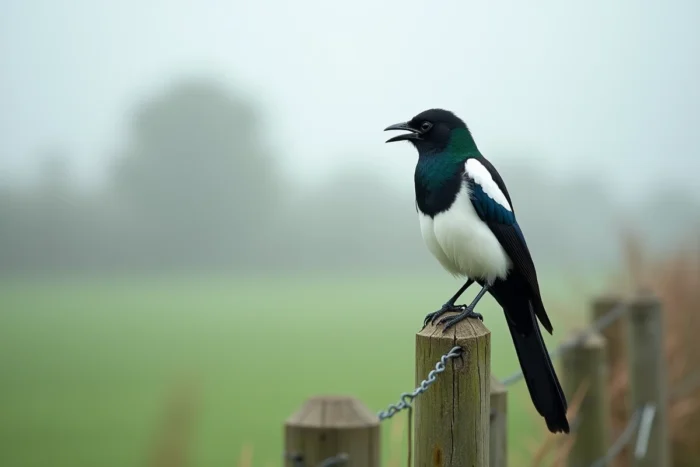
A series of harsh cries shatters the calm of the garden, and the magpie flies up to the top of a poplar. This characteristic sound, a mix of chattering and barking, accompanies the daily lives of millions of French people without them really knowing what it means. The Eurasian magpie (Pica pica) belongs to the corvid family, birds known for their remarkable cognitive abilities, and its call serves functions far more precise than mere chitchat.
Understanding the magpie’s cry begins with accepting to look at this black and white bird differently: not as an omen or a nuisance, but as an animal that communicates with a true vocal grammar.
Decoding the vocalizations of the Eurasian magpie
Have you noticed that the magpie’s cry changes depending on the situation? A rapid and repeated chattering has nothing to do with a brief and isolated call. The magpie uses distinct vocal sequences to alert its group, defend its territory, or signal a predator.
The alarm call, for example, is a staccato sequence of high-pitched notes. It serves to warn other magpies (and sometimes other bird species) that danger is approaching. A cat in the garden, a raptor in flight: each type of threat triggers a specific vocal variant.
Besides alerts, the magpie also produces softer, almost whispered sounds during interactions between partners or between parents and young. These contact vocalizations often go unnoticed because they are discreet. However, they reflect a rich vocal repertoire, adapted to various social contexts.
To learn everything about the magpie’s cry, one must observe the context as much as listen to the sound: the bird’s posture, the presence of other animals, and the time of day provide clues about the meaning of the cry.
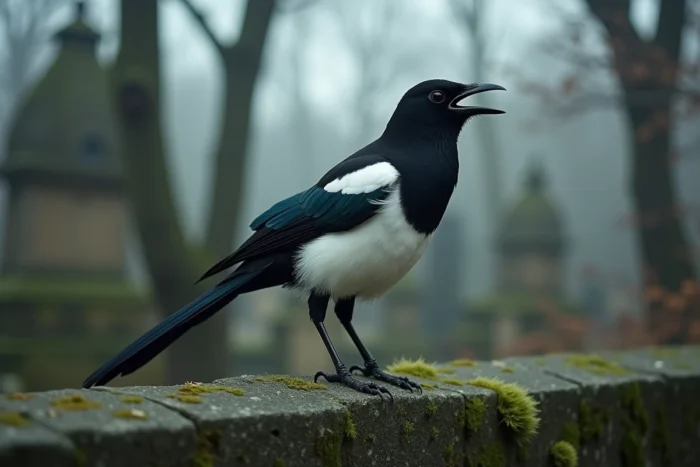
Thieving magpie and bird of misfortune: where do these beliefs come from?
The reputation of the magpie is based on centuries of superstitions. In European folklore, encountering a single magpie was considered a sign of bad luck. Two magpies, on the other hand, heralded good news. These popular nursery rhymes have passed through generations and continue to fuel the idea that the magpie carries a message, whether positive or negative.
The other major myth concerns the theft of shiny objects. The magpie is said to be attracted to jewelry, coins, anything that sparkles. Recent research shows exactly the opposite. Rather than attraction, magpies exhibit strong neophobia: when faced with an unfamiliar shiny object, they retreat or avoid it.
This neophobia is also reflected in their vocal behavior. An unusual object placed near the nest triggers alarm calls, not silent curiosity. The image of the thieving magpie thus belongs to the realm of myth, firmly rooted in popular culture but contradicted by field observations.
A contested official classification
The Eurasian magpie remains classified among species likely to cause damage in several French departments. This status allows trapping and shooting, while its ecological role is largely underestimated. Pesticides used in agriculture also destroy its food resources (insects, small invertebrates) and can directly poison it.
Magpie populations have gradually moved towards urban and suburban areas, where food remains accessible and persecution is less frequent. This phenomenon explains why magpies are heard more in the city than in the countryside.
The magpie’s cry as an indicator of biodiversity
Hearing magpies regularly in a garden or neighborhood is not a sign of nuisance. It is rather a signal of a functioning ecosystem. The magpie actively participates in the natural environment in several ways:
- It regulates insect and larval populations, limiting pests without chemical intervention.
- It cleans up carrion and organic waste, playing a discreet but real sanitary role.
- It contributes to seed dispersal, promoting plant regeneration in green spaces.
The frequency of magpie cries reflects the quality of the local habitat. A garden with hedges, mature trees, and diverse vegetation attracts more magpies than a mineral space without resources. Conversely, a complete absence of magpies in an area may indicate a decline in biodiversity.
This ecological angle remains underutilized. Articles about magpies focus on beliefs or symbolism, rarely on what their presence concretely reveals about the health of a territory.
Intelligence and self-awareness in the magpie
The magpie is one of the few animals that pass the mirror test. Placed in front of its reflection, it identifies a colored mark placed on its body and tries to remove it. This behavior, also observed in great apes and dolphins, indicates a form of exceptional self-awareness in a bird.
This intelligence manifests itself daily. Magpies hide food in dozens of different locations and remember them. They adapt their strategy if they know they are being watched by a peer, moving their caches to avoid theft.
A social animal with group codes
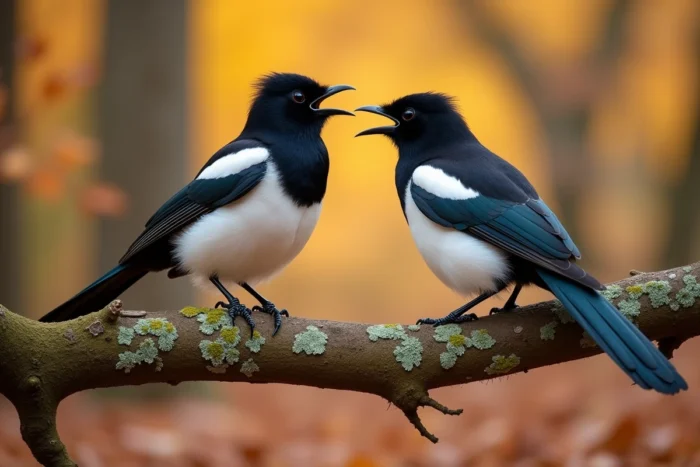
Magpies often live in family groups or small gatherings. The collective chattering sometimes heard, called “magpie ceremony,” corresponds to complex social interactions: resolving territorial conflicts, strengthening bonds between individuals, or collective reactions to danger.
These noisy gatherings are not chaos but organized communication. Observing a solitary magpie crying and a group chattering together is not the same situation, and the reasons for the cry differ radically.
The next time a magpie lets out its shrill cry from your roof, take a few seconds to look at what is happening around it. The context always provides more information than superstition. A bird that alerts, calls its partner, or defends its young tells a much more concrete story than an omen of good or bad fortune.