Even if we know the basic principles (move, eat balanced, sleep enough), the hardest part remains anchoring them into an already busy day. Improving well-being and taking care of health on a daily basis doesn’t necessarily require major upheavals. It’s often targeted adjustments, tailored to one’s actual rhythm, that make a difference over time.
Daily Mental Health: What the National Cause Changes
Since January 2025, mental health has officially been a National Cause in France, extended into 2026. This label, exceptional in its duration, is based on four concrete axes: de-stigmatization, prevention, access to care, and support in daily life. We are no longer in the realm of disconnected individual advice.
In practice, this means that early detection systems are being deployed in schools, businesses, and local structures. If one feels persistent discomfort, the approach of consulting a professional is now supported by an institutional framework, making the first step easier.
There are also structured resources available on dedicated health platforms, such as https://allp-sante.com/, which help navigate among the various care and prevention pathways.

Work-Related Sleep Disorders: A Priority Field Constraint to Address
Sleep is often talked about as a pillar of health, but rarely about what concretely degrades it. Work-related sleep disorders still affected nearly half of French employees recently, although this figure is starting to decline. Work-related irritability is also decreasing, but these improvements remain fragile.
Identify the Real Problem Before Seeking a Solution
Before buying a melatonin supplement or downloading a meditation app, it’s beneficial to make a simple diagnosis. Differentiating between a falling asleep problem and a nighttime awakening problem completely changes the approach.
- If it takes more than thirty minutes to fall asleep regularly, the problem is often related to overstimulation at the end of the day (screens, work emails checked in bed, blue light).
- If one wakes up between three and five in the morning without being able to fall back asleep, it’s frequently a signal of chronic stress or untreated mental load.
- If one sleeps a correct number of hours but wakes up exhausted, the quality of sleep (apneas, noise environment, room temperature) deserves to be evaluated by a professional.
Each case calls for a different response. Feedback varies greatly from person to person regarding the effectiveness of the “miracle” routines seen everywhere.
Nutrition and Well-Being: Going Beyond the Shopping List
Competitors list all the same recommendations: fruits, vegetables, whole grains, good fats. This isn’t wrong, but it doesn’t solve the underlying problem. The real difficulty is eating properly when you have twenty minutes for lunch.
Prepare Rather Than Choose Under Constraint
When one has to decide what to eat at noon with hunger and lack of time as the only advisors, one almost always ends up with a mediocre choice. Batch cooking on Sunday or Wednesday evening remains the most reliable method to bypass this bias.
We’re not talking about preparing five gourmet meals. It’s about cooking a large quantity of proteins (chicken, lentils, hard-boiled eggs), a carbohydrate (rice, whole pasta), and washing ready-to-eat vegetables. Three containers in the refrigerator are enough to cover the week’s lunches.

Physical Activity Without a Gym: Integrating Movement into Your Day
Everyone knows that exercise is good for health. The problem is that most people neither have the time nor the desire to sign up for a gym. And it’s not a lack of will; it’s a logistical constraint.
The most sustainable approach is to attach movement to existing habits. Getting off the subway one stop early, consistently taking the stairs, walking during phone calls: these micro-adjustments cumulatively produce measurable effects on physical and mental well-being.
Two Complementary Practices Accessible Without Equipment
- Brisk walking for thirty minutes a day significantly reduces perceived stress and improves sleep quality. It requires no equipment and adapts to all levels.
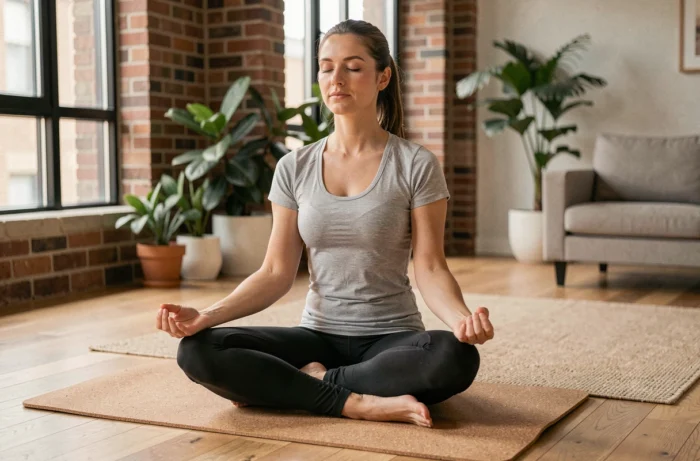
- Floor yoga, even for ten minutes in the morning, works on flexibility, breathing, and stress management. Many free resources are available in video format to start without investment.
- Dynamic stretching at the end of the workday (especially when working from home) helps release accumulated tension in the neck, shoulders, and lower back.
You don’t need athletic performance to take care of your body. The regularity of moderate movement matters more than the occasional intensity of a session.
Prevention and Mind-Body Balance: A Daily Investment
Health prevention isn’t limited to the annual check-up with the doctor. It plays out in the micro-decisions of daily life: choosing to go for a walk instead of scrolling, turning off notifications after a certain hour, giving your mind moments without stimulation.
The link between body and mind is not a vague formula. Chronic stress manifests physically through muscle tension, digestive disorders, and decreased immunity. Acting on one means acting on the other. Controlled breathing practices (like heart coherence) take five minutes and can fit between two meetings.
Daily well-being doesn’t rely on a complete overhaul of one’s lifestyle. It is built through repeated, modest but consistent choices that eventually become automatic. It’s this silent accumulation that produces the most lasting results.