
Sterdex is an ophthalmic ointment packaged in single-dose soft capsules, combining dexamethasone and oxytetracycline. Its unique format, a small capsule that needs to be pierced and then squeezed into the eye, requires unusual actions compared to a simple eye drop. Improper handling reduces the amount of active ingredient deposited in the conjunctival sac, which directly compromises the effectiveness of the eye treatment.
Sterdex single-dose capsule: a format that requires precise technique
Most application errors do not stem from a lack of goodwill, but from the format itself. Sterdex is neither a liquid eye drop nor a traditional ointment tube. It is a soft capsule that must be opened correctly, oriented, and squeezed with a calibrated motion.
The capsule is pierced by twisting it, not by cutting it with scissors or biting it (two reflexes documented in pharmacy practice). The twisting creates a clean opening without projecting ointment outside the capsule. An opening that is too wide causes some of the content to be lost even before contact with the eye.
To successfully apply Sterdex ophthalmic ointment, the pierced end must be oriented downwards, held above the lower conjunctival sac (the pocket formed by pulling down the lower eyelid), and then gently squeeze the capsule between the thumb and index finger. All the contents of the capsule must be deposited in a single squeeze. Interrupting the action to reposition the capsule causes ointment to spill onto the cheek or eyelashes.
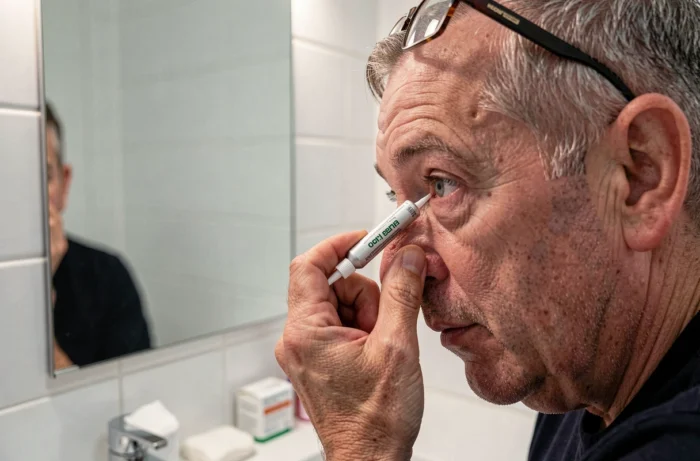
Order of instillation when Sterdex is co-prescribed with eye drops
This is a point that medication leaflets rarely address with sufficient clarity. When a doctor prescribes Sterdex in addition to one or more eye drops, the order of administration changes everything.
The ophthalmic ointment must always be applied last, after the eye drops. The reason is physical: the greasy texture of the ointment forms a film that blocks the passage of any liquid instilled afterward. An eye drop applied after the ointment slides over this lipid layer without reaching the ocular surface.
Between each eye drop, a delay of at least five minutes is recommended to allow the first product to be absorbed. The Sterdex ointment concludes this sequence. In practice, this means that a patient using three eye drops and one ointment should plan for about fifteen minutes for the entire protocol, morning and evening as prescribed.
- Instill the first eye drop, wait five minutes with eyes closed without excessive blinking.
- Instill the second eye drop (and the third if applicable), respecting the same delay between each product.
- Apply the Sterdex capsule last, once the eye drops have had time to penetrate the ocular surface.
Reversing this order is a frequent source of loss of treatment effectiveness, noted in several guides on the proper use of ophthalmic forms.
Hand hygiene and contamination of the Sterdex capsule
Washing hands before any ophthalmic manipulation seems obvious. In practice, the difficulty is more subtle: the fingers must be dry after washing. Wet hands make the capsule slippery, complicate the twisting open, and increase the risk of contamination from tap water (which is not sterile).
The single-dose capsule is designed for one-time use. Once pierced, even if some of the content remains inside, it should not be saved for later use. The opened package loses its sterility within minutes.
Contact between the capsule and the eye
The tip of the capsule should never touch the surface of the eye, the eyelashes, or the eyelid. This contact contaminates the opening of the capsule and introduces bacteria into the remaining ointment at the moment of pressure. The ideal distance is a few millimeters above the conjunctival sac.
Tilting the head back and looking up facilitates access to the lower eyelid and reduces the blinking reflex. Some patients find it easier to lie down for this step, which stabilizes the head and frees both hands.

Treatment duration and risks associated with prolonged use
Sterdex contains dexamethasone, a corticosteroid. This anti-inflammatory component is effective against ocular inflammation, but it imposes a treatment duration strictly framed by the prescribing physician.
Prolonged use of ophthalmic corticosteroids can lead to an increase in intraocular pressure. This risk increases with the duration of treatment and with certain patient profiles (history of glaucoma, high myopia). Never extend Sterdex beyond the prescribed duration, even if symptoms persist, as the anti-inflammatory effect sometimes masks an underlying worsening.
The leaflet also mentions a risk of secondary fungal infection with prolonged use. Oxytetracycline (the associated antibiotic) does not cover fungi. Treatment that lasts too long alters the local microbial flora and can promote superinfections that Sterdex does not treat.
When to consult a doctor during treatment
Any decrease in vision, unusual eye pain, or worsening redness after a few days of treatment warrants a quick return to the ophthalmologist. These signs may indicate a complication related to the corticosteroid or an infection that does not respond to oxytetracycline.
Wearing contact lenses is not recommended during the entire duration of treatment. The greasy base of the ointment alters soft lenses and creates an opaque film that disrupts vision for several hours after each application.
Sterdex remains a prescription medication, prescribed for specific ocular inflammations where the corticosteroid-antibiotic combination is justified. Mastering the application technique, respecting the order of instillation, and not exceeding the prescribed duration are the three parameters that truly determine the treatment outcome.