
The FFJDA extranet is the platform where all operations related to the ranks of licensed judokas take place: registration for exams, tracking results, and belt approval. For a club leader or a teacher, mastering this portal helps avoid missing documents, processing delays, and back-and-forth communication with the regional league.
Role of the club president and the teacher in grade validation
The federal texts for 2026/2027 specify that the validation of registrations for grade exams falls under the responsibility of the club president and the teacher. This formalized responsibility means that no registration can be processed on the extranet without the approval of these two parties.
In practice, the president confirms the administrative eligibility of the judoka (up-to-date license, no disciplinary sanction), while the teacher certifies the technical level. The extranet embodies this double verification through a two-step validation system, visible in the “grades” module of the club space.
A club that wishes to manage grades on the FFJDA extranet smoothly should establish an internal calendar: the teacher prepares the list of candidates, and the president validates the batch before the registration deadline set by the CORG.
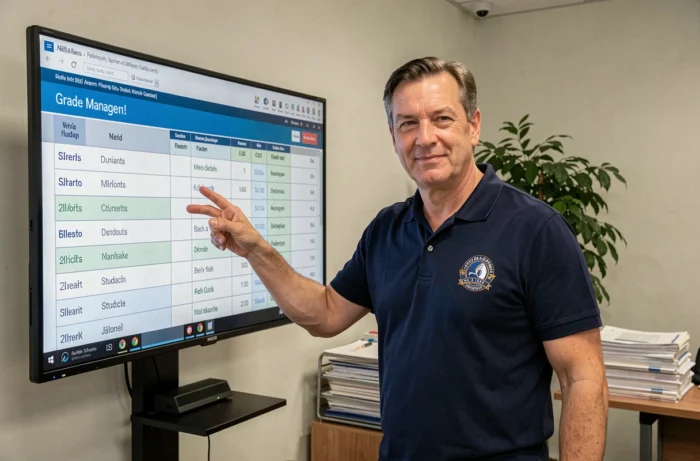
Registrations for dan exams on the FFJDA extranet
Since the redesign of the extranet, registrations for grade exams are done exclusively online. Submissions by mail or paper forms sent to the league are no longer accepted for dan candidates.
Prerequisites to check before launching a registration
Before opening the registration module, three points deserve systematic verification:
- The judoka’s sports passport must be filled out and up-to-date on the extranet, with the history of previous belts correctly recorded.
- The license for the current season must be active. A license pending payment blocks the registration on the server without an explicit error message.
- Competition points (for grades concerned by the UV system) must appear in the candidate’s record. If results are missing, the correction request goes through the CORG, not through the club.
These checks take a few minutes per candidate. Performing them in advance, rather than on the deadline day, eliminates most of the technical blockages encountered by clubs.
Process of data entry
The interface requires selecting the candidate from the list of licensed members of the club, then choosing the targeted grade and the desired exam session. The system then displays a summary with any alerts (missing document, deadline not respected between two grades).
Validating the registration generates an acknowledgment of receipt that can be consulted in the club’s history. This acknowledgment serves as proof in case of a dispute regarding the consideration of a file.
Grade results and the role of CORG on the extranet
The regional grade commissions (CORG) play a central role in the digital chain. According to the 2026/2027 regulations, the results of the tests are entered by the CORG directly on the extranet, and then recorded in the judoka’s grade book.
The club does not need to record the results of a dan exam itself. However, it is responsible for ensuring that the results appear on the licensed member’s record in the weeks following the session. A lack of update after a reasonable period justifies a report to the relevant CORG.
This centralization makes the extranet the unique reference for federal traceability of grades. The paper passport remains an official document, but it is the digital data that prevails in case of discrepancies.

Approval of foreign grades and JJB grades via the extranet
Clubs regularly welcome judokas trained abroad or practitioners of Brazilian jiu-jitsu (JJB) whose grade must be recognized by the federation. The procedure involves standardized forms available in PDF on the federal website.
The completed file is sent digitally to a dedicated FFJDA address. The club can track the progress of the request from the extranet once the file is registered on the federal side. For 5th and 6th dan applications, specific forms exist, with additional supporting documents (technical memory, proof of experience).
Common errors in approval files
The first source of rejection concerns untranslated documents or illegible copies of diplomas. The second is sending the file to the wrong address (regional league instead of the dedicated federal service). Checking the exact recipient on the “Regulations and Procedures” page of the federal website before any submission avoids a back-and-forth of several weeks.
A club managing multiple approval cases per season benefits from maintaining an internal tracking table with the date of submission, the relevant license number, and the status returned by the federation. The extranet does not yet offer a dedicated dashboard for these specific requests.
The management of grades on the FFJDA extranet relies on a clear distribution of responsibilities between the club, the teacher, and the CORG. Exclusively digital registrations, centralized entry of results, and standardized forms for special cases create a coherent administrative circuit. The main point of vigilance remains the prior verification of each candidate’s prerequisites, which conditions the smoothness of the entire process.